
Gravity Switch Stage 16 to 20 Walkthrough
Gravity Switch stages 16 to 20 chain portals: how one launch feeds the next pair, and the order that keeps every dot on the line you already travel.
Quick answer: block four stops teaching portals and starts stacking them. The rooms are built so that the exit of one portal pair is the entry of the next, which turns a single push into a route across three screens. The skill is to trace the whole chain before the first push and check that each link's exit has somewhere to stop. If you are still unsure what a single portal does, the first portal block→ has the ground rules.
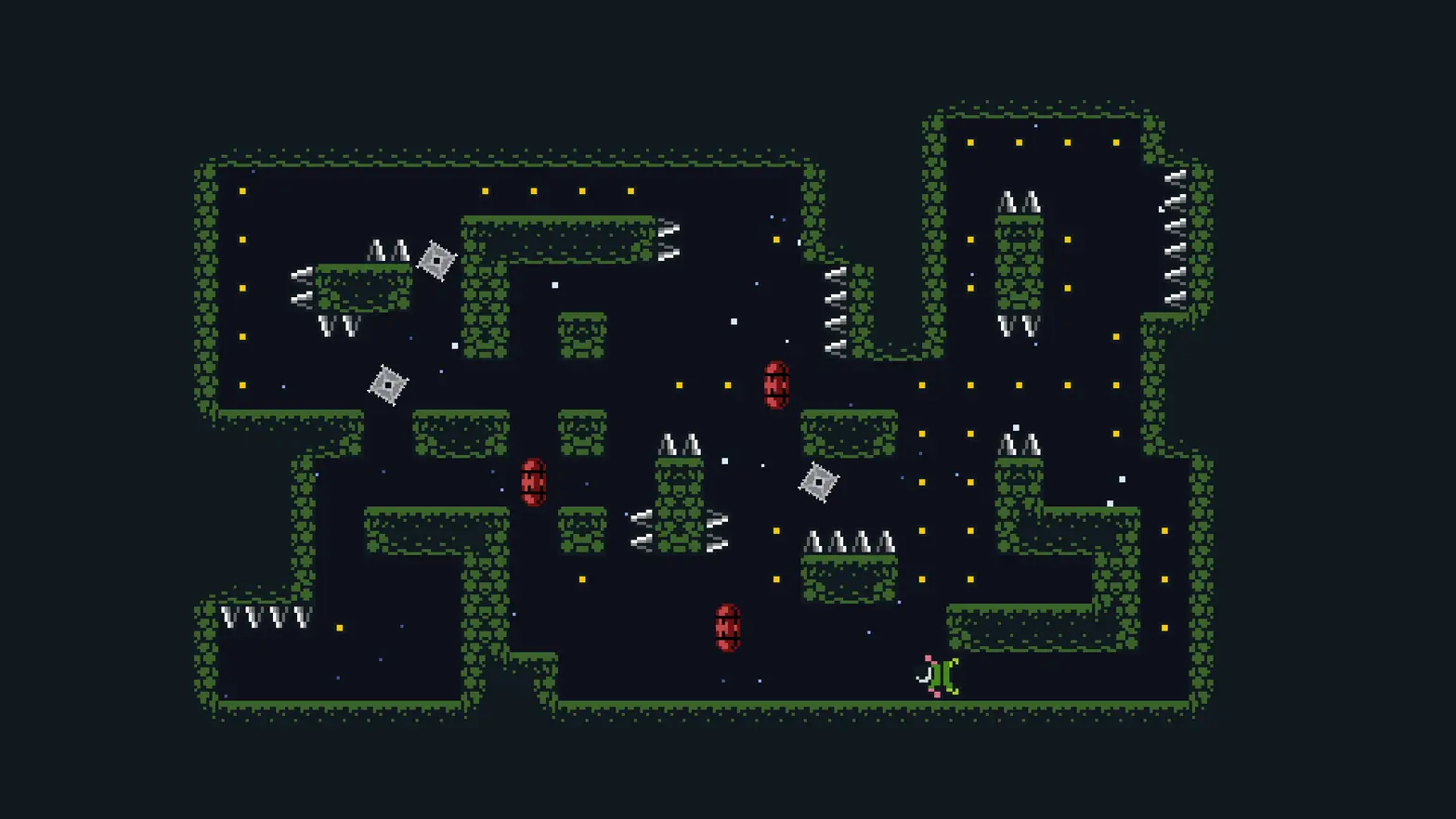
How a chain works
A portal chain is just repeated transfer:
- You enter pair A heading right, leave pair A heading right.
- Pair B's entrance sits on that line, so you enter it without a new input.
- You leave pair B still heading right, and the room's far wall ends the slide.
Nothing in the game resets your heading except a wall or a portal, so a chain room is really a question of alignment: are the pairs arranged so that one heading carries you through all of them? In the violet palette you can read this from the floor, because the portal tiles are laid out in visible columns.
| Stage | What it is testing | The mistake to avoid |
|---|---|---|
| 16 | Two pairs on one heading | Breaking the line with an early wall stop |
| 17 | A chain that turns a corner | Forgetting the second portal changes the lane, not the direction |
| 18 | A chain with a dot between links | Assuming the chain collects the middle dot |
| 19 | Two chains, one room | Taking the chain you can see instead of the one you need |
| 20 | Chain plus spike frame | Using a chain that exits into the frame |
Stage 16: the straight chain
The first room of the block has two pairs on the same heading. From the entry wall, one push should carry you through both and into the far wall. The reason it is not automatic is that a wall between the pairs will stop you mid-chain if you enter on the wrong lane.
Read the lane first, then push. If you stop between the pairs, you are one lane off, not out of position.
Stage 17: the corner chain
Stage 17 turns the chain: the first pair sends you across the room, the second sends you along the perpendicular axis. This is where players lose track of heading, because the visual rotation of the room makes it feel like the direction changed.
It has not. The second pair's exit fires you in the direction you entered it, which is the direction the first pair gave you. Trace it once with a finger before pushing.
The chain rooms reward a slow first attempt and punish exploratory ones. One traced route beats five guesses.
Stage 18: the dot between links
The trap stage of the block. A dot sits between two portal pairs, on a tile your chain passes over, and the natural assumption is that passing collects it. It does — but only if you pass over the dot's tile, not beside it. A one-lane offset is the difference between a clean chain and a dot left behind.
If the counter still shows a dot after the chain, that is exactly what happened. Restart and shift one lane.
Stage 19: two chains
Stage 19 gives you two complete chains and one of them is a decoy: it looks shorter but exits into the half of the room you have already cleared. The useful chain is the one whose exit lands in the uncleared half.
Before pushing, ask which half of the room still has dots. Then take the chain that ends there.
Stage 20: chain into the frame
The last room of the block sends a chain's exit toward the spike frame from stage 8. The frame is not a wall: entering it on the wrong lane means a restart, not a stop.
The clean route uses the chain to reach the frame's open side, clears the frame on foot, and takes the crystal on the return lane. If a chain exits at the frame, do not take that chain until the frame is empty.
Block pacing
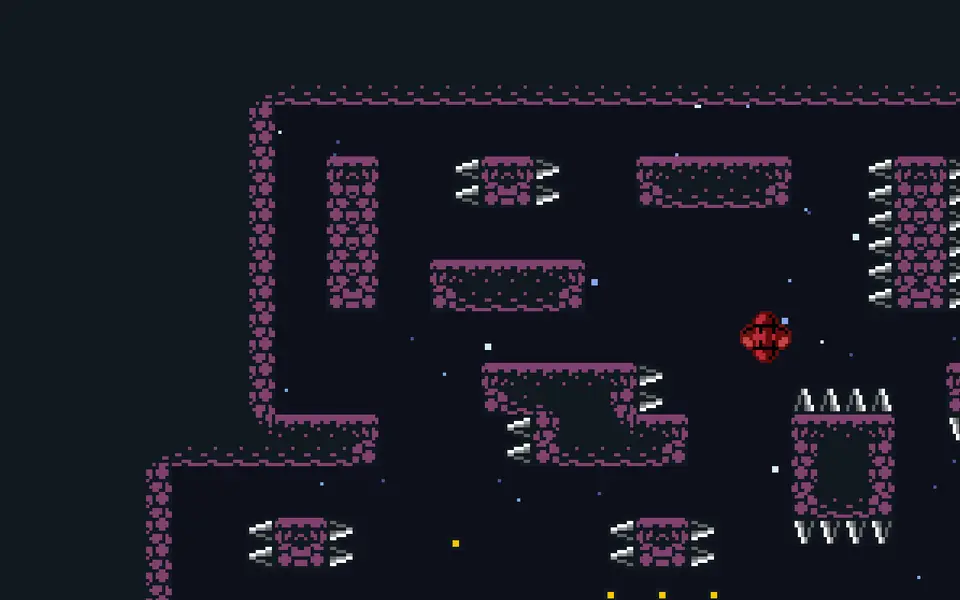
Twenty to thirty minutes, and the variance is large: a player who traces routes before pushing finishes this block in fifteen, and a player who explores finishes in forty. The stage 21 to 25 walkthrough→ adds moving blades, which is the first hazard that changes while you are looking at it, so the tracing habit you build here carries straight over.
If a room in this block feels impossible, the usual cause is a chain that needs to be entered from the opposite side. The mechanics page→ explains why entering backwards is often the answer.
Inference source: route notes follow the block's portal-chain progression and the official violet screenshots, which show portal tiles arranged in columns. Gravity Switch has no replay export, so the notes describe alignment logic rather than tile coordinates.
Official source: Steam store page ↗ for the portal and environment progression; Nintendo eShop listing ↗ for the Switch build.; the PlayStation Store listing ↗ for the PS5 release; ERMedia ↗ for the developer's release history.
FAQ
What is a portal chain in Gravity Switch?
Two or more portal pairs arranged so that one heading carries you through each of them without a new input.
Do chains collect dots automatically?
Only dots on the tiles you pass over. A dot one lane off the chain is still a separate problem.
Why do I stop in the middle of a chain?
A wall tile sits on your lane between two pairs. Shift one lane and the chain completes.
Can I enter a portal from the side?
Yes, and the exit direction follows your entry direction, so entering from the opposite side is a legitimate routing tool.
Should I clear a chain room from the far end?
Often yes. Starting at the far wall lets the chain carry you back through the dots you still need.