
Gravity Switch Stage 11 to 15 Walkthrough
Gravity Switch stages 11 to 15 add portals. How a portal pair transfers a slide, why the exit needs a wall behind it, and the order that clears the block.
Quick answer: block three adds the portal, the first element that moves you without a slide. A portal pair takes you in at one end and drops you out of the other, and your momentum continues in the direction you were travelling. The whole block is about one question: what is behind the exit portal? If the answer is a wall, the portal is a stop. If the answer is open floor, the portal is a launch. The hazards page→ lists the portal rules in full.
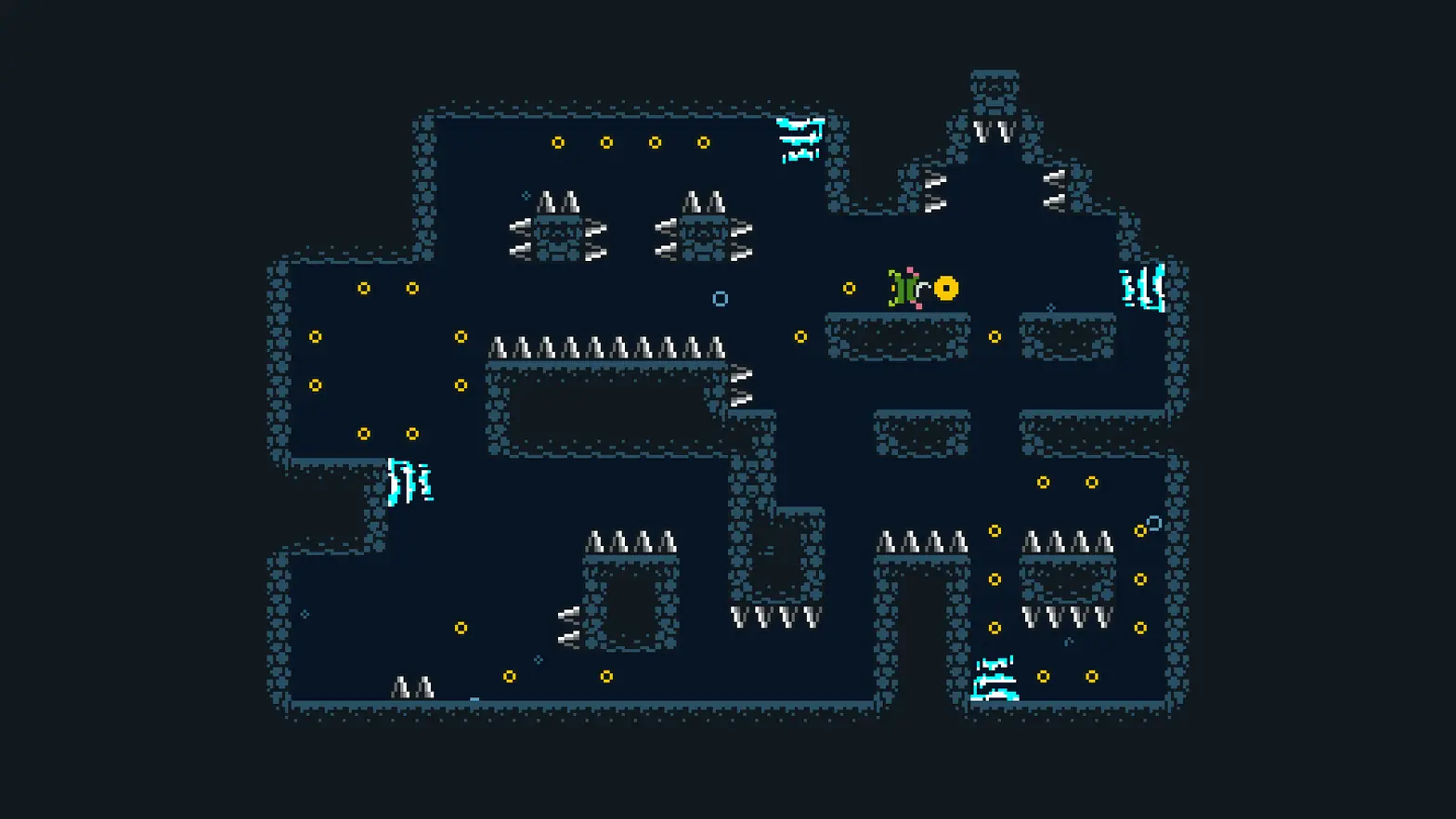
What a portal actually does
The behaviour that matters in these five stages:
- Entry keeps your heading. Push right into a portal and you leave the second portal still travelling right.
- The exit needs a backstop. If a wall sits behind the exit portal, you stop there. If not, you keep sliding.
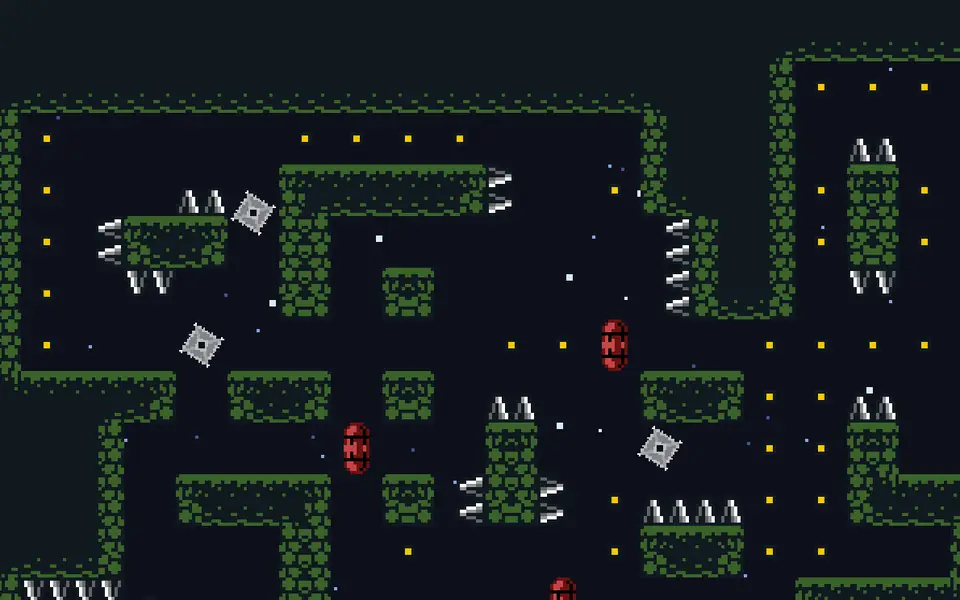
- Altars are not decoration. In the forest palette the portal tiles sit on carved stone markers, which is how you spot a pair before you use it.
- Portals do not collect for you. A dot one tile off the exit line is still a separate problem.
The forest block is the first environment change in the game, and it also moves the HUD: the dot counter at the bottom of the screen becomes the thing you check between attempts.
| Stage | What it is testing | The mistake to avoid |
|---|---|---|
| 11 | A single portal pair, wall behind the exit | Entering before checking the exit side |
| 12 | A portal whose exit opens into a room | Treating it as a stop instead of a launch |
| 13 | Two pairs in one room | Entering the wrong pair |
| 14 | A dot next to a portal mouth | Skipping the dot and launching past it |
| 15 | Portals plus a spike pocket | Using the portal to escape a pocket you still need dots from |
Stage 11: the first pair
The first portal room is deliberately simple. Enter the near portal and you come out of the far one facing the same direction, with a wall close enough to stop you. That wall is the lesson: a portal is safe to use when something behind the exit tile will catch you.
Walk the room's edge before you push. You are looking for two portal tiles with the same marker, and for the wall that sits on the far side of the second one.
Stage 12: the launch
Stage 12 removes the backstop. The exit portal opens into a long room instead of against a wall, so your heading carries you across the floor until something else stops you — usually a wall, occasionally a spike edge.
The correct approach is to treat the launch as a slide you did not initiate: pick the lane you will land in first, then pick the entry. If the landing lane ends at spikes, do not use the portal from that side.
A portal transfers direction, not speed. The only thing that changes your heading is a wall or a second portal.
Stage 13: two pairs
Two portal pairs in one room is the first real routing puzzle of the game. The pairs are not interchangeable: one exits toward the dots and one exits toward the crystal, and using them in the wrong order leaves you sweeping the room twice.
Before the first push, mark which pair serves which half of the room. Then clear the half with more dots first, because the crystal half is usually a single slide.
Stage 14: the dot at the mouth
Stage 14 puts a dot right beside a portal mouth, close enough that players assume the portal collects it. It does not. Approach the dot on a line that ends on a wall, take it, then come back to the portal from the correct side.
This is the stage where the two-second rule pays for itself: if you cannot say where the slide ends, you have not read the room.
Stage 15: portal plus spike pocket
The last room of the block combines the portal with the spike pocket from stage 8. The pocket's dot is reachable, but the portal's exit line runs past it, so using the portal to leave the pocket early strands the dot.
Clear the pocket on foot, then use the portal. If you have already launched, restart: coming back around the room costs more than the reset.
How long the portal block takes
Fifteen to twenty-five minutes on a first run. Most of that is not dying, it is standing still and working out which way the exit portal fires you.
Once the exit-side rule is automatic the block collapses to ten minutes, and the stage 16 to 20 walkthrough→ is where the game starts chaining portals so that one launch feeds the next. The mechanics page→ has the general form of the rule if you want it stated once, cleanly.
Inference source: room notes follow the block's hazard progression and the official forest screenshots, which show portal tiles on carved altars and the dot counter in the HUD. No replay export exists, so routes are described as logic rather than tile maps.
Official source: Steam store page ↗ for the portal mechanic and the every-five-stages environment change; Nintendo eShop listing ↗ for the handheld build.; the PlayStation Store listing ↗ for the PS5 release; ERMedia ↗ for the developer's release history.
FAQ
When do portals appear in Gravity Switch?
In the third block of stages, starting at stage 11.
Do portals change the direction you are travelling?
No. You leave the exit portal still heading the way you entered.
What happens if nothing is behind the exit portal?
You keep sliding until a wall, a blade track or a spike edge stops you. That is what makes stage 12 the block's teaching moment.
Can a portal take me backwards?
Only if you enter it from the opposite side. The pair transfers your heading, so the entry side decides the direction.
Why did I skip a dot after using a portal?
Because the exit line did not pass through it. Portals move you, they do not collect.