
Gravity Switch How Many Levels: All 50 Stages
Gravity Switch has 50 stages in ten five-stage environments. Here is the full block list, what counts as finishing a stage, and how long each block takes.
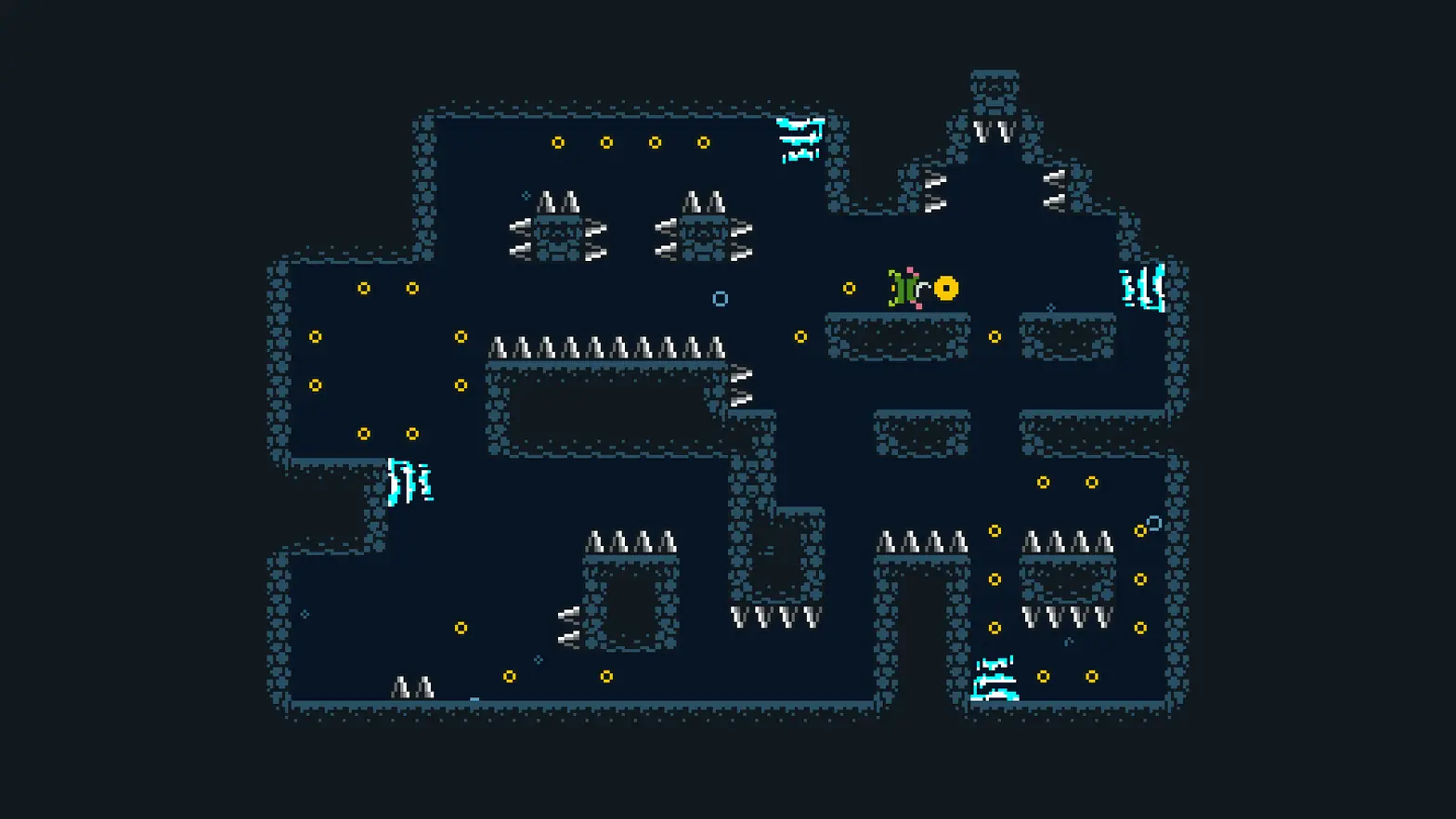
Quick answer: 50 stages, grouped into ten environments of five stages each. The game does not hide a second set behind the credits, and there is no endless or daily mode, so the count you see on the store page is the whole game. Each stage ends when every dot in the room is collected and you touch the warp crystal, which is also the only exit. The wiki overview→ has the platform and price details; this page is only about the count and the structure behind it.
How many stages does Gravity Switch have?
Fifty. ERMedia describes them as hand-built rather than generated, and the store copy says a new environment unlocks every five stages, which gives a clean ten-block structure you can use to plan a session.
| Block | Stages | Environment change |
|---|---|---|
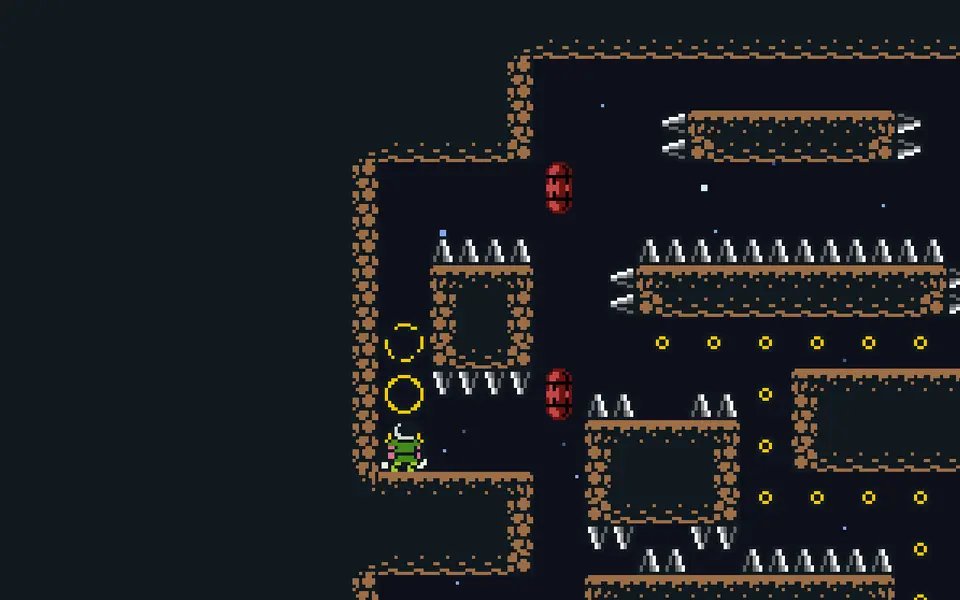
| 1 | 1 to 5 | Stone temple palette, first spike walls |
| 2 | 6 to 10 | Cooler stone and metal, longer corridors |
| 3 | 11 to 15 | Green forest tones, first portal pairs |
| 4 | 16 to 20 | Violet rooms, portal chains |
| 5 | 21 to 25 | Desert and rust, blade rows |
| 6 | 26 to 30 | Pale crystal halls |
| 7 | 31 to 35 | Elite temple variants |
| 8 | 36 to 40 | Deep caverns |
| 9 | 41 to 45 | Moss and overgrowth |
| 10 | 46 to 50 | Final mixed set |
Inference source: the five-stage grouping comes from ERMedia's own "new environments unlock every 5 stages" line. The palette names in the right column are how the blocks read in the official screenshots, not labels the game puts on screen.
What counts as finishing a stage?
Three things have to be true before the room lets you leave:
- Every dot collected. The counter at the bottom of the screen tracks what is left. The crystal stays dark while any dot remains, so a run that reaches the crystal early does nothing.
- The crystal touched. Once the room is empty, the warp crystal activates and ends the stage. It is a physical object you have to reach, not a menu prompt.
- You are alive. Spikes and blades kill on contact. Death is a restart of that stage only, and the restart is instant, which is why the game can afford to be this strict.
That means the stage count is not the same as the attempt count. A stage like any in the 31 to 35 block can take ten restarts and still be a single stage on the list.
Are there secret or bonus stages?
No. There is no alternate exit, no collectible beyond the dots, and no unlockable stage set. The 50 on the stage counter are all of it, and finishing stage 50 ends the run. What the game does have instead of bonus content is replays: because the room logic is deterministic, a stage you brute-forced can be replayed for a clean route, and that is where most of the replay value sits.
Watch the row of remaining-dot icons rather than the character. Two dots left and a clear lane to the crystal is a solved room; two dots left behind a blade timing window is not.
How long does each block take?
Blocks of five stages run 8 to 15 minutes once you understand the block's new hazard, and 20 to 30 minutes if the hazard is new to you. That puts the full 50 at roughly 2 to 4 hours, with the middle blocks taking the longest because that is where portals and blades start sharing rooms.
| Section | Stages | First-run time | Clean replay |
|---|---|---|---|
| Opening | 1 to 10 | 15 to 25 min | Under 10 min |
| Middle | 11 to 30 | 45 to 80 min | 20 to 30 min |
| Late | 31 to 45 | 40 to 70 min | 15 to 25 min |
| Final | 46 to 50 | 15 to 30 min | 5 to 10 min |
The how long to beat→ page explains where those ranges come from, including why a first run of the final block can double.
Is 50 stages enough for $7.99?
It depends on how you count. At three hours for a first run, the price is about $2.60 an hour, which is normal for a short indie puzzler and better than most $20 puzzle games that pad their stage count with variations. The honest caveat is that 50 is not a large number, and the game is over when it is over. There is no stage editor and no score attack, so if you need a hundred hours of content this is the wrong purchase.
What it does do is respect the stage count. Every stage is a room with a real idea, and the ten-environment structure means the art and the hazard set move together instead of repeating with a new colour palette.
How the count is laid out for guides
This site covers the 50 stages in the same ten blocks the game uses, because per-stage pages for a 50-stage game produce 50 thin pages that cannibalise each other. Each block page explains the block's new hazard, the order of operations that solves most rooms in it, and the three ways players lose runs. If you are stuck on one stage inside a block, the block page is the right page. Start at the opening block→ and work forward.
Official source: Steam store page ↗ for the 50-stage and five-stage-environment description; Nintendo eShop listing ↗ for the single-player mode.; the PlayStation Store listing ↗ for the PS5 release; ERMedia ↗ for the developer's release history.
FAQ
How many levels are in Gravity Switch?
50 stages across ten environments of five stages each.
Are there 50 or 51 stages?
- The counter ends at stage 50 and the credits follow it.
Do you have to collect every dot?
Yes. The warp crystal does not activate while a dot remains in the room.
Can you skip a stage?
There is no skip. The stages run in order and each one has to be finished to move on.
Is there a stage select screen?
The store pages do not describe one, and nothing in the official screenshots shows a stage map. Treat the run as linear.