Gravity Switch Hazards: Spikes, Blades, Portals
Every Gravity Switch hazard explained: spike walls, saw blade cycles, portal transfers and narrow lanes, with the rule that decides each one.
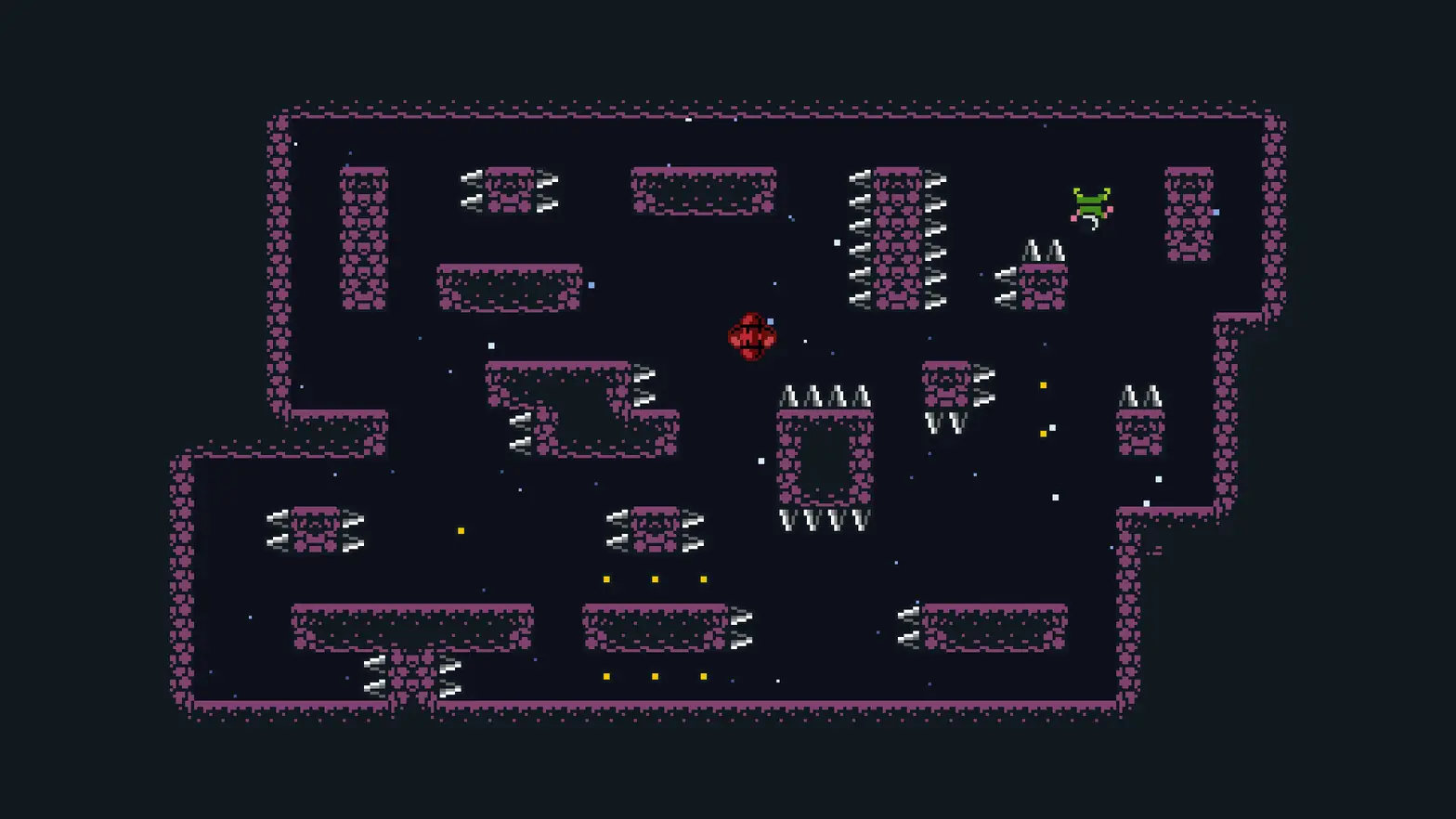
Quick answer: Gravity Switch has four hazard families, and the developer lists them in release order: spike traps, moving blades, portal pairs and narrow escape lanes. Spikes and blades kill on contact and end the slide where you touched them, portals redirect you instead of killing you, and narrow lanes are a layout constraint rather than an object. The order matters, because the game teaches them one block at a time, and each one changes what "safe stop" means. The mechanics page→ explains the slide itself; this page is about the things that ruin it.
What hazards are in Gravity Switch?
| Hazard | Kills | Stops a slide | First shows up |
|---|---|---|---|
| Spike walls and spike floors | Yes | Yes, fatally | Opening block |
| Saw blades, static | Yes | Yes, fatally | Early middle blocks |
| Saw blades, moving on a track | Yes | No, they pass | Middle blocks |
| Portal pairs | No | Redirects you | Forest and violet blocks |
| Narrow escape lanes | Indirectly | Constrains the route | Middle and late blocks |
Inference source: the four families come from ERMedia's own store description. Which block introduces each one is our reading of the official screenshots and the stage order, not a labelled hazard list from the game.
Spike walls: the honest hazard
Spikes are the least interesting hazard and the most important, because they turn a wall into a decision. A normal wall is a stop you can use. A spike wall is a stop that kills you, which means the whole slide that ends there must be re-planned, not adjusted.
Two habits handle spikes:
- Never push toward a spike wall unless the dot you want is the last tile before it. Landing one tile short of spikes is the classic death in the first twenty stages.
- Use spikes as a boundary, not a stop. If a room has spikes on the north edge, the room is telling you not to travel north. Plan the route along the other three edges and only cross the spike edge if a dot forces you.
In some slide games a spike tile only damages you at speed. In Gravity Switch the description is blunt: you die on contact. Treat every spike as a wall you cannot touch.
Saw blades: timing versus placement
Static blades behave exactly like spikes: contact kills, and the blade is a stop. Moving blades are different in one crucial way: they are not stops, they are a window. If a blade crosses the lane you are about to slide down, your push has to be timed so that you pass behind it.
That changes the planning order. With spikes, plan the route. With moving blades, plan the route and then the beat:
- Find the lane the blade crosses.
- Watch one full cycle from a safe tile. Most cycles are short enough to read in a few seconds.
- Push after the blade passes, not before it arrives. Pushing early means you arrive at the crossing tile while the blade is still there.
- If the cycle is long, consider whether the blade can be avoided entirely by approaching from the other side.
The desert block and the moss block use blades the most, and the late blocks put a blade on the only lane to the crystal, which is why a stage can be solved in your head and still take five attempts.
Portals: the hazard that is not a hazard
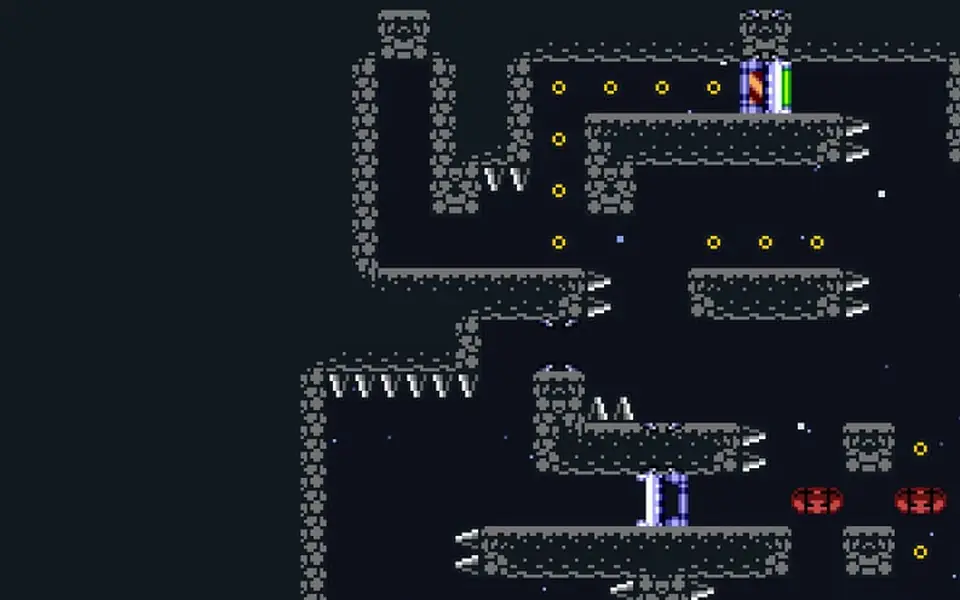
Portals do not kill. They relocate. In the screenshots they read as tall glowing gates with a matching partner, and in the violet block they come in chains where one slide passes through two of them.
The three rules the walkthroughs on this site use:
- A portal keeps your direction. Enter moving right, exit moving right, until something stops you.
- A portal does not collect dots for you. Dots on the skipped segment stay where they are, which turns a "shortcut" into a longer route.
- A portal can be a stop. If the exit tile faces a wall, the portal is effectively a wall you cannot see, which is useful for landing on an isolated dot.
The most common portal mistake is entering one that exits into a spike lane two tiles later. Follow the exit direction to its stopping point with your eyes first.
Narrow lanes: the layout hazard
Narrow lanes are not an object. They are a room built so that the safe path is one tile wide, usually between two spike fields. What makes them hard is not precision, it is that a one-tile lane leaves no room for a second attempt: you either land inside the lane or you die at its mouth.
The method that works is to enter the lane from the end that lets you exit into open floor rather than into the next lane. In practice that means solving narrow-lane rooms backwards: start at the crystal, walk the lane in your head toward the dot cluster, and push from the side that makes the last slide of the route the short one.
How the hazards combine
The last three blocks mix all four, and the combinations follow a pattern worth memorising:
| Combination | The trap | The fix |
|---|---|---|
| Spikes plus portal | Portal exits into a spike lane | Enter from the other side |
| Blade plus narrow lane | Lane is safe but the entrance is not | Wait for the blade, then commit |
| Two portals plus dots | Shortcut skips a dot | Take the long way once |
| Blade plus crystal | Crystal sits in the blade's path | Time the final slide, do not rush it |
The stage 31 to 35 walkthrough→ is the block where these combinations first stack, and it is the best place to practise reading two hazards at once.
Do hazards ever change after the first pass?
No. A stage is deterministic: the same push from the same tile always produces the same result, and blade cycles do not randomise between attempts. That is why restarting is free information. Each attempt that dies tells you exactly where the lane ends, and the next attempt can use that.
Official source: Steam store page ↗ for the spike, blade, portal and narrow-lane progression; Nintendo eShop listing ↗ for the ESRB E rating and mild fantasy violence descriptor.; the PlayStation Store listing ↗ for the PS5 release; ERMedia ↗ for the developer's release history.
FAQ
Do saw blades kill instantly?
Contact with a blade ends the stage, the same as a spike.
Can you pass through a portal mid-slide?
Yes. Portals are entered by sliding into them, and the slide continues from the partner portal in the same direction.
Are moving blades on a fixed cycle?
Yes. Nothing in the game randomises hazard timing, so a cycle you have seen once is the cycle you will get on the next attempt.
What is a narrow escape lane?
A one-tile-wide safe path between hazard fields. It is a room layout rather than an object, and it appears most in the middle and late blocks.
Do spikes only hurt from one side?
No. Any contact kills, from any direction.